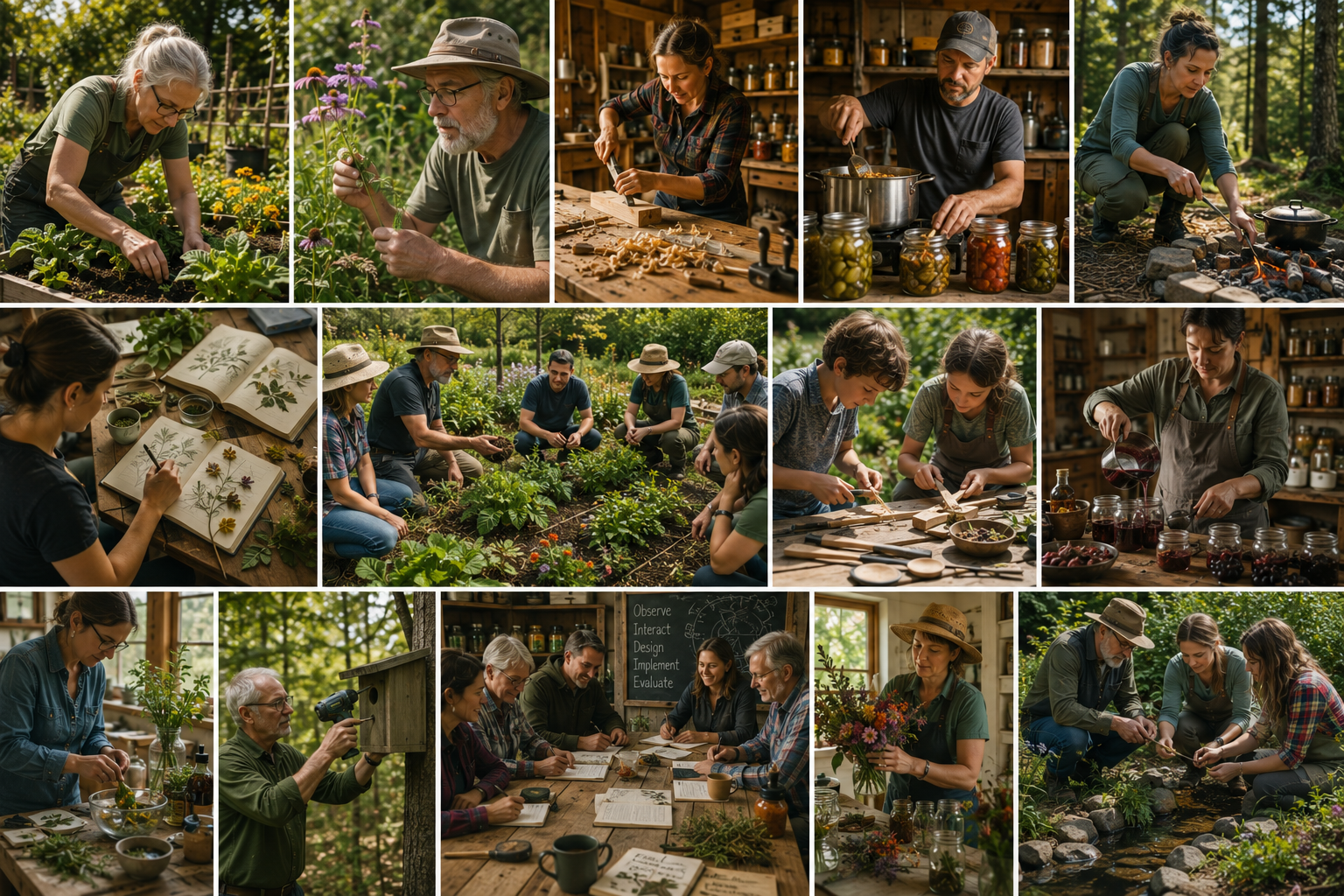
Homesteading ยท Food Preservation ยท Urban Farming ยท Outdoor Safety ยท Naturalist Studies ยท Winter Power Out Survival
Bringing full Classes to any Community. See our current lineup of classes below.
Don't forget to check out our Facebook page for newsletters, handy tips, and more!
Upcoming Events
Dobbinton, Ontario
Registration Now Open!
Experience an immersive outdoor educational adventure focused on Wilderness Skills, Team Building, Personal Challenges, Ecology, Sustainability, and Urban Farming.
Each day features six engaging one-hour activity blocks that combine hands-on learning with outdoor exploration. Participants will enjoy a diverse range of experiences, including EcoTours, nature journaling, planting and gardening activities, building projects using hand and power tools, crafting, games, quiet reflection time, and practical outdoor skills such as shelter building, fire lighting, and navigation using map and compass.
Every participant will create and complete projects to take home each day, all of which are included in the course fee.
This program is designed to challenge participants physically, mentally, and socially. Success requires a willingness to engage fully in outdoor activities, demonstrate resilience and mental stamina, work cooperatively with others, and maintain appropriate behavioural self-control throughout the day.
Participants should be prepared for a full day of outdoor activity in varying weather conditions and terrain.
WHO'S IN CHARGE:
The Lead Instructor holds a 2026 VSC and First Aid Certificate, has Army Reserve Training, was a Scouting Leader for many years including leading an off-grid camp, ran youth activities at various public schools, plus portaged Algonquin Park and lived off-grid.
The Program's Assistant Leader held the rank of Warrant Officer in the Air Cadet Program, and was awarded the Lord Strathcona Medal along with other awards during their career. This rank required leadership of younger members along with course creation and instruction.
Cost: $450 per child. All forms must be completed in order to qualify, and payment must be received in full to reserve a spot.
Participants are required to sign a Hold Harmless Indemnification and a Code of Conduct Agreement.
Bring a Class to Your Community
Less popular but perhaps a more useful method of canning, this method gives you the ability to create your own ready-to-eat meals like soups and stews the way you like them.
This class will give you:
- The basics of canning food safety
- The difference between canning methods and why they must be followed
- An understanding of food spoilage and what is safe
- Tips on selecting equipment and ingredients, plus money saving options
- How to work all types of recipes (new and old)
Some hands-on opportunities while canning a veggie or soup (whatever is in season locally) will take you through every step of the process. You will leave with the knowledge to can anything you choose in the future.
Limited class size for the best experience.
What to bring: Hair covering, apron, shoes with a good grip, water bottle, paper and pen
Allergen Alert: All equipment has been used for all kinds of food. Epipen users should ensure someone on site has access to personal treatments.
Instructor is a multiple 1st Place winner at local Fall Fairs, winning Best of Show 2022 at the Owen Sound Fall Fair, and has a current Safe Food Handler Certificate.
PREREGISTRATION REQUIRED: Fresh ingredients in the correct quantities must be gathered by the instructor.
COST: $40 per person. Deposit required to reserve a spot.
Cancellation/Refund Policy: Refunds will only be issued if the instructor cancels the class.
Best taught as a demonstration in 90 min, 3+ hrs if students wish to participate.
This is the classic method of canning high-acid foods like fruits, pickles, jams, jellies, and tomatoes (with added acid).
This class will cover:
- Canning food safety principles
- Equipment needed and money-saving options
- Step-by-step process for water bath canning
- Testing seals and storing your creations
- Recipe guidelines and adjustments
Hands-on: Participants will help prepare and can a seasonal fruit or vegetable.
What to bring: Hair covering, apron, water bottle, paper and pen
Allergen Alert: All equipment has been used for all kinds of food.
COST: $40 per person. Deposit required to reserve a spot.
Cancellation/Refund Policy: Refunds will only be issued if the instructor cancels the class.
Duration: 2-3 hours depending on class size and participation level.
Learn how to create your own just-add-water meals for camping, emergency preparedness, or convenience.
Topics covered:
- Choosing the right dehydrator for your needs
- Food safety and dehydration principles
- Pre-treatment of foods
- Rehydrating techniques
- Creating complete meals from dehydrated ingredients
- Storage and shelf life
Hands-on: Participants will help prepare ingredients for dehydration and assemble a sample meal to take home.
What to bring: Apron, water bottle, paper and pen
COST: $45 per person. Deposit required to reserve a spot.
Duration: 2-3 hours
Practical strategies for ensuring your family has access to nutritious food during emergencies, shortages, or financial difficulties.
Topics include:
- Building a pantry on a budget
- Growing food in small spaces
- Foraging basics
- Food preservation methods (overview)
- Storing water and emergency supplies
- Community resources and bartering
This is a lecture-style class with handouts and discussion.
What to bring: Water bottle, paper and pen
COST: $30 per person
Duration: 1.5 - 2 hours
Understanding the "why" behind successful gardening practices.
Topics include:
- Soil science and testing
- Plant biology and growth requirements
- Photosynthesis and plant energy
- Nutrient cycles and fertilizers
- Pest and disease management
- Seed saving and propagation
This class is ideal for gardeners who want to move beyond following instructions to truly understanding their garden.
What to bring: Water bottle, paper and pen
COST: $35 per person
Duration: 2 hours
Permaculture is a design system for creating sustainable human habitats by following nature's patterns.
This introductory class covers:
- The three ethics of permaculture
- Observation and site analysis
- Zone and sector planning
- Water management
- Soil building
- Plant guilds and companion planting
- Integrating animals
- Applying permaculture to small spaces
You will leave with ideas for starting your own permaculture project, no matter how small your space.
What to bring: Water bottle, paper and pen, photos of your space (optional)
COST: $40 per person
Duration: 2-3 hours
Be prepared for unexpected situations when you venture outdoors.
This class covers:
- The 10 essentials for any outing
- Trip planning and leaving a trip plan
- Navigation basics (map and compass)
- Weather awareness
- Hypothermia and heat illness prevention
- Basic first aid for the outdoors
- Emergency shelters and signaling
- What to do if you become lost
This class includes hands-on practice with basic skills.
What to bring: Water bottle, paper and pen, dress for being outside
COST: $40 per person
Duration: 2-3 hours
Building on basic outdoor safety, this advanced class dives deeper into wilderness living skills.
Topics include:
- Advanced fire-making (bow drill, flint and steel)
- Natural shelters
- Wild edible and medicinal plants
- Water sourcing and purification
- Advanced navigation (GPS and traditional)
- Knife and axe safety
- Emergency signaling
This class involves significant outdoor time and hands-on practice.
Prerequisite: Outdoor Safety Training or equivalent experience.
What to bring: Water bottle, lunch, sturdy shoes, dress for being outside all day
COST: $60 per person
Duration: 4-5 hours (full day)
A "Get Home Bag" (GHB) is a kit designed to help you get back to your family and home if disaster strikes while you are away.
This class covers:
- Assessing your personal risks and needs
- Choosing the right bag
- Essential categories (navigation, first aid, tools, food/water, shelter, communication)
- Seasonal adjustments
- Vehicle vs. office vs. personal carry
- Budget-friendly options
- Maintenance and rotation of supplies
Hands-on: Participants will work on planning their own GHB.
What to bring: Water bottle, paper and pen
COST: $30 per person
Duration: 1.5 - 2 hours
Packing Get Home Bags - Full class details coming soon.
Learn to identify plants anywhere, anytime, using a simple, systematic approach.
This class covers:
- Basic plant morphology (parts of a plant)
- Using botanical keys
- Identifying features to look for
- Common plant families
- Edible, medicinal, and poisonous plants
- Apps and resources for plant ID
- Ethical foraging practices
Includes a guided walk to practice identification skills (weather permitting).
What to bring: Water bottle, sturdy shoes, camera or phone for photos, paper and pen
COST: $40 per person
Duration: 2-3 hours (includes outdoor walk)
Focused workshops on specific canning projects. Topics rotate seasonally and may include:
- Jam and Jelly Making
- Pickling (dill pickles, bread and butter, beets)
- Salsa and Tomato Products
- Pie Fillings
- Pressure Canning Meat and Broth
- Fermented Foods (sauerkraut, kimchi)
Each workshop is hands-on and you will take home a finished product.
What to bring: Hair covering, apron, water bottle, paper and pen, jars (optional)
COST: $45 per workshop
Duration: 2-3 hours
Maximize your garden harvest in minimal space using these proven techniques.
Square Foot Gardening covers:
- Building a SFG grid
- Soil mix recipe
- Plant spacing by square
- Succession planting
Companion Planting covers:
- Plants that help each other grow
- Pest-deterring plant combinations
- Trap crops and beneficial insect attractors
- Crop rotation basics
You will leave with a planting plan for your own garden.
What to bring: Water bottle, paper and pen, measurements of your garden space (optional)
COST: $35 per person
Duration: 2 hours
Maximize your garden harvest in minimal space using these proven techniques.
Square Foot Gardening covers:
- Building a SFG grid
- Soil mix recipe
- Plant spacing by square
- Succession planting
Companion Planting covers:
- Plants that help each other grow
- Pest-deterring plant combinations
- Trap crops and beneficial insect attractors
- Crop rotation basics
You will leave with a planting plan for your own garden.
What to bring: Water bottle, paper and pen, measurements of your garden space (optional)
COST: $35 per person
Duration: 2 hours
What People Are Saying
About the Instructor
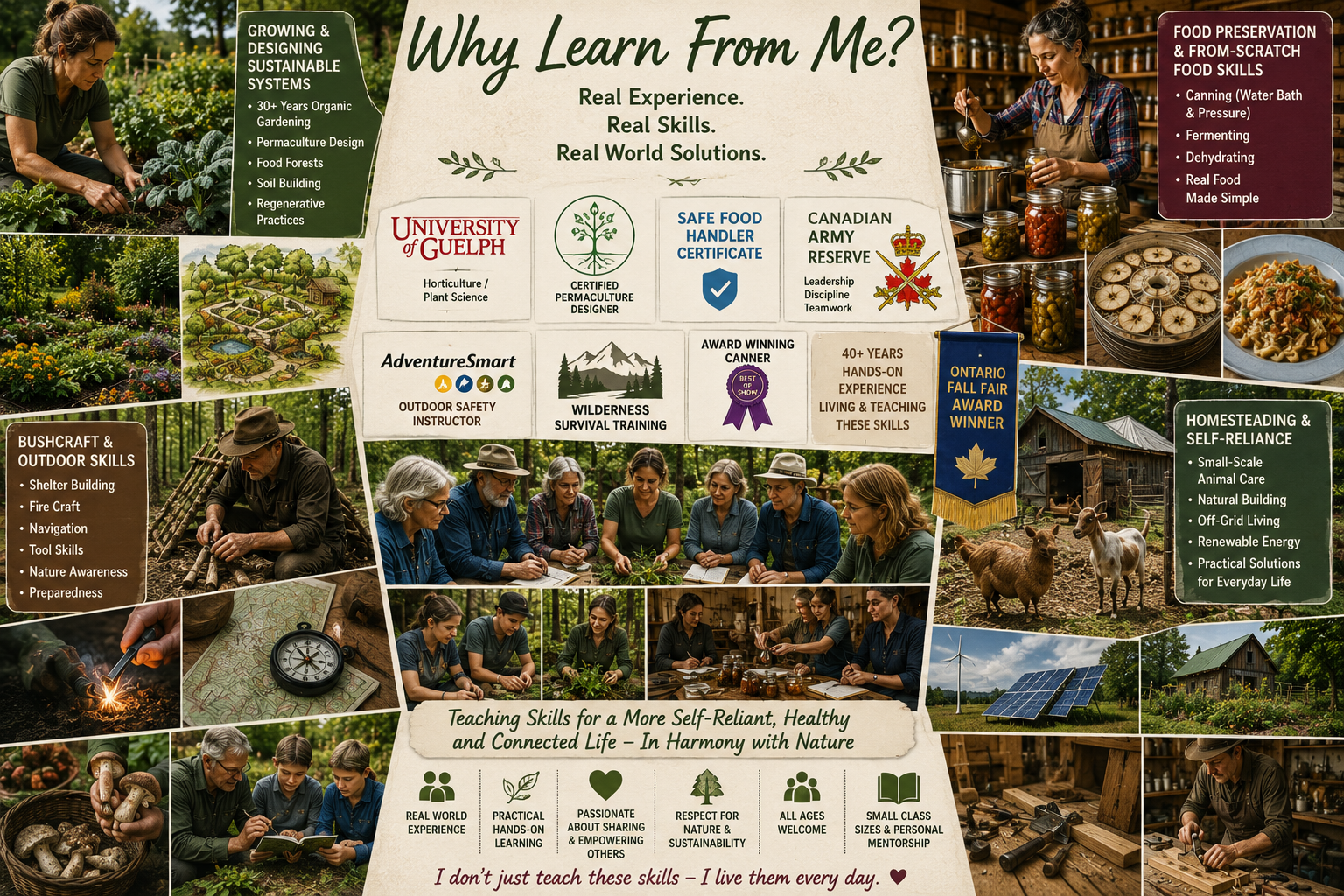
My love of nature has always been a large part of who I am. As a kid I preferred being outside and my first summer job was at a Garden Center. That experience anchored my interest in all things that grow. I went on to attend University of Guelph for Horticulture and had a small landscape/garden maintenance hustle for a short while. Although life can sometimes redirect our efforts, being outside and observing how things grow and interact stayed a fundamental part of who I was.
Spending 5 years training with the Army Reserves, portaging Algonquin park, taking Wilderness Survival training with WSC, living off-grid for a short time, and being a Scout Leader for years culminating in an off-grid camp for 10-14 year olds solidified my comfort and appreciation for the outdoors.
When my young family's health needs required us to go back to cooking from scratch, eliminating all artificial cleaners, perfumes, soaps and such, I had to take the time to research and reapproach how I fed my family and kept my home. Food was a large focus then and still is.
I now live on a small "food farm" incorporating our needs with the wonderful wildspace that is our plot of land. Using only the space we need, and doing the least harm, we now provide most of our own meat from field to freezer without leaving the property. Our 40x80' garden incorporates French-intensive/square foot methods, Espalier, no till, companion and succession planting. What we can't grow, we are fortunate to be able to source from traditional growers in the neighbourhood.
Our changes on the property have achieved full integration as we again have top predators comfortable on our land. Although we may lose a chicken now and again, the bald eagles stopping by are truly majestic. We have begun our quest to establish a more off-grid sustainable system and are now focusing on solar power, water systems, a Walipini and dug cold cellar. We are also building a cantina (cold room) to store even more root vegetables conveniently indoors.
Through these research then trial-and-error projects, my grandmothers were a great inspiration. I would think "Well, how did they do it?" and my love for the late 1800/early 1900's agricultural and home skills methods blossomed. The lost crafts and ingenious pre-industrial revolution methods of making work easy without electricity became an odd hobby of mine.
During visits with new friends I would get asked "Can you teach a class in that?" and so I started teaching. That was five years ago. Sharing knowledge and seeing people enthusiastic for a new adventure which also improves their lives gives me goosebumps. Teaching is now truly a love almost as strong as being outside.
๐ฑ Homesteading / Urban Farming Skills
- Currently homesteading on a small hobby farm with kids and livestock in an area where the power goes out often
- Canning for over a decade
- Safe Food Handler's Certificate
- Permaculture Design Certification
- Practicing "Permie" for 10+ years
- 30+ years as an organic gardener
- Studied Horticulture (Bio-Sci) at University of Guelph
- Naturalist
๐๏ธ Outdoor / Naturalist Skills
- Trained with the Army Reserves
- Wilderness Survival training from WSC
- "AdventureSmart" Certifications
- Multiple portages into Algonquin park
- Scouting leader for many years, including off-grid camps
- Foraged with years of success
- Lived off-grid with kids and livestock
โ Valid Insurance Certificate โ Current Vulnerable Person Police Records Check
โ Shelley
Contact & Booking
๐ Location: Chatsworth, Ontario, Canada
๐ง Email: sdchernoff@outlook.com
๐ Facebook: Follow us
๐ Gift certificates available!
We travel to your location - Ontario only. Classes can be customized for any age or interest level.